Introduction
Ask any electrical contractor or utility technician what “reliable” means in a crimping tool, and you won’t get an answer about price or brand name first — you’ll get an answer about what happens on a bad day. A tool that loses hydraulic pressure mid-crimp in the middle of nowhere. A battery that dies halfway through a joint bay splice. A crimp that looks complete but isn’t, because the tool released before reaching full force. Reliability in this category isn’t a marketing word — it’s a safety and compliance requirement, because a failed crimp on a power cable isn’t a minor defect. It’s a serious risk waiting to happen.
That’s the standard AOI holds every tool we source to, and it’s why Maxell Izumi — a Japanese manufacturer building hydraulic crimping tools since the 1960s is the brand we recommend especially to customers across the Middle East and Africa. This post breaks down what actually makes a crimping tool reliable, and why Izumi’s engineering choices consistently hold up against that standard better than most of the alternatives on the market.
What “Reliable” Actually Means in a Crimping Tool
Before recommending any tool as “the best,” it’s worth being specific about what reliability is actually built from:
- The tool completes every crimp to full rated force — no exceptions. A tool that can release early under operator fatigue or low battery isn’t reliable, it’s a liability.
- It fails safe, not silent. If something does go wrong mid-crimp — battery cutout, hydraulic fault — there needs to be a way to recover the tool and the connector without guessing.
- It performs consistently across years and thousands of cycles, not just out of the box.
- It doesn’t strand your die or battery investment if you scale up, add tools, or need parts years later.
- It’s backed by real support, not a tool you replace the moment something wears out.
Not weight, not price, not brand recognition — are what separate a genuinely reliable crimping tool from one that just looks the part on a spec sheet.
Where Izumi Delivers on Each of These
1. Full-force, ratchet-verified crimps. Even Izumi’s manual hydraulic tools use a ratchet mechanism that physically cannot release the jaws until the full preset pressure has been applied — the operator cannot accidentally under-crimp by stopping early. On the current battery range, a rapid ram advance mechanism is a standard listed feature, carrying that same principle forward: fast approach to the connector, then controlled full-force compression, every cycle.
2. A genuine fail-safe, not just a warning light. Across Izumi’s current battery range — including the S7G and S7L series — a manual retract button that does not rely on the battery is a standard listed feature, alongside electronically controlled auto-retract. In practice, that means there’s a physical way to release the tool if the battery or electronics fail while the jaws are closed. On elevated or live work, that’s the difference between a controlled recovery and a genuinely dangerous situation.
3. Manufacturing consistency backed by ISO 9001. Izumi tools are manufactured in Japan under ISO 9001 quality systems, which is what actually keeps crimp force consistent tool to tool and batch to batch — the exact outcome a crimping tool exists to guarantee. This consistency matters most in compliance-heavy sectors like utility inspection, oil & gas, and rail, where a crimp has to meet spec every time, not most of the time.
4. Cross-brand die compatibility. Izumi’s standard 12-ton crimping tools accept the same industry-standard 12-ton U-type dies used across other major brands, including tooling built for Burndy, Klauke, and Cembre. That protects a customer’s existing die inventory instead of locking them into a single proprietary ecosystem — a real risk with several lower-cost imported tools designed specifically to force repeat parts purchases.
5. Runs on the Makita battery you probably already own. Most of Izumi’s standard battery operated tools run on the common 18V Makita lithium-ion battery. That matters more than it sounds: Makita batteries are sold almost everywhere, so if a battery is lost, damaged, or simply flat, a replacement or charger is easy to find on short notice, even on a remote site. And if your crew already runs Makita power tools, the crimper can share the same batteries and chargers already on the truck instead of adding another charging system to manage. It’s a small detail that removes a real point of failure — a job doesn’t stop because one specific battery brand isn’t available locally.
6. Built to need less servicing in the first place. The most reliable tool isn’t necessarily the one with the biggest service network behind it — it’s the one that breaks down less often to begin with. Izumi’s approach leans on that: mechanically simple, physically verifiable fail-safes (the ratchet lock on manual tools, the manual retract button on battery tools) instead of purely electronic systems that have more that can go wrong; ISO 9001-controlled manufacturing that keeps tolerances and crimp-force output consistent unit to unit; and a hydraulic design that has been refined across seven generations of the same product line rather than reinvented each time. That combination is what lets these tools stay in daily field use for years with minimal downtime.
7. Genuine, traceable sourcing. Reliability starts before the tool is even used — it starts with knowing the tool in your hand is a genuine, correctly specified unit rather than an unverified import. As a sourcing partner working directly with the Izumi supply chain, AOI supplies only genuine tools with full manufacturer documentation, so you know exactly what you’re putting in a technician’s hands.
Matching Tool Type to the Job
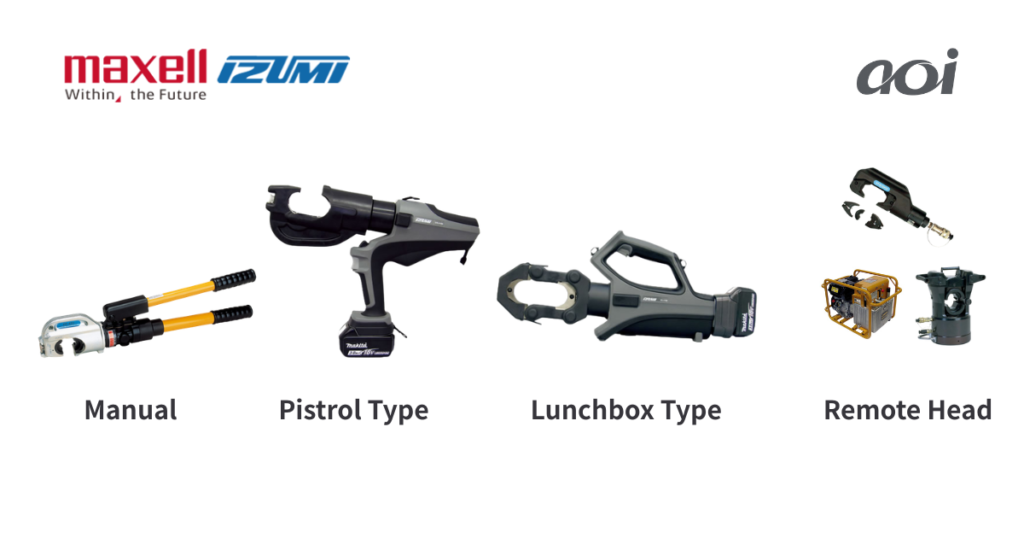
Reliability isn’t only about the tool itself — it’s also about not asking the wrong tool to do a job it wasn’t built for.
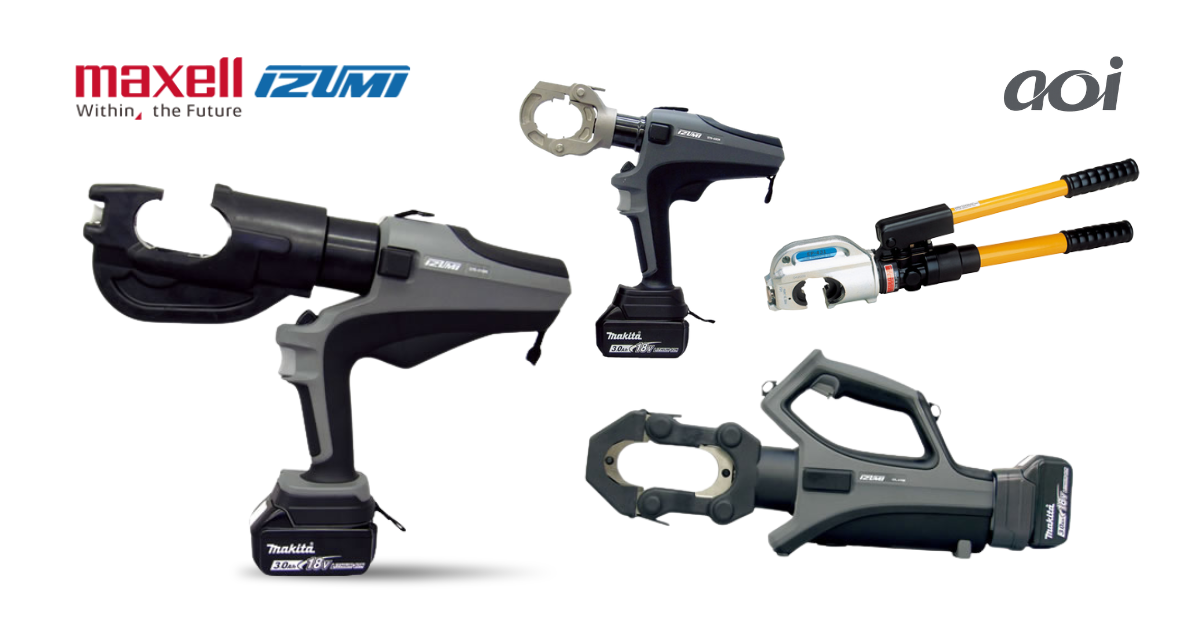
- Manual hydraulic tools (EP-431, EP-510C) — no battery, no charging, dependable as a primary tool for lower-volume work or as equipment where power access isn’t guaranteed.
- Battery-operated pistol tools (S7G series) — one-hand operation for overhead, bucket-truck, and switchgear work where the other hand needs to hold position.
- Battery-operated lunch box tools (S7L series) — higher force and faster cycle times for ground-based, high-volume termination work, up to the 15-ton S7L-610M flagship.
- Remote hydraulic heads (EP-200W) — for very high tonnage work or multiple tools sharing one pump station.
Choosing the right category for the job is itself a reliability decision — a battery pistol tool pushed past its rated tonnage, or a manual tool used for high-volume production crimping, will wear out and fail faster than a correctly matched tool at half the price.
Industries Where Reliability Isn’t Optional
- Power Transmission & Distribution — a failed field crimp on a live conductor is a direct safety incident, not just a rework cost
- Oil & Gas / Industrial Plants / Mining— instrumentation and power cable terminations in environments where a connection failure can mean unplanned shutdown
- Telecommunications — aerial and duct cable terminations where access for rework is expensive and slow
- Rail & Transit — signaling and traction power terminations subject to strict compliance inspection
- Switchgear & Panel Building — terminations inside enclosures where a loose or incomplete crimp can go undetected until it fails under load
- Marine & Ports — corrosion-prone environments where a consistent, full crimp is the only thing standing between a connection and salt-air degradation
Where to Buy
AOI is your direct sourcing partner for genuine Maxell Izumi crimping tools, supplied from Japan to customers across the Middle East, Africa, and worldwide.
- Genuine, traceable tools with full manufacturer documentation and warranty— no counterfeit risk
- Guidance matched to your actual application, not just the biggest spec sheet
- Bulk and fleet sourcing for utilities, EPC contractors, and industrial distributors
- Total sourcing support for other Japanese industrial tools, PPE, and testing equipment
Need a tool you can actually depend on in the field? Contact AOI for a quote or help matching a reliable, genuine Izumi crimping tool to your project.