Introduction
If you work in power distribution, railway maintenance, telecom, or civil work, you already know that a cheap, unreliable puller isn’t just an inconvenience, it’s a safety risk. That’s why professionals across Japan and more than 30 countries rely on Nagaki Seiki, a Japanese manufacturer that has built ratchet pullers, wire grips, and hot-line tools for the electrical and construction industries since 1946.
At AOI (AOI-DBI LLC), we source genuine Nagaki Seiki tools directly from Japan and supply them to customers across the Middle East and Africa, along with the rest of the world. In this guide, we’ll break down the three main types of Nagaki pullers — chain type, wire type, and strap (web) type — explain how to choose the right one for your application, and show you where the different models fit across industries like power utilities, oil & gas, telecom, and construction.
Why Nagaki Seiki?
Nagaki Seiki is an Osaka-based manufacturer with over 75 years of experience designing professional-grade tools for live-line and construction work. Their ratchet pullers, wire grips, tension meters, and insulated hot-line tools are used by power utilities, railway companies, and telecom operators around the world, and are widely regarded as a benchmark for quality and durability in this category.
One important note for buyers: Nagaki Seiki has publicly warned customers about counterfeit and imitation products circulating in some markets — tools with removed or altered serial numbers, or unauthorized modifications, that can fail under load and put workers at risk. This is exactly why sourcing through an authorized, traceable supply chain matters. As an authorized channel for genuine Nagaki products, AOI ensures every unit we supply is 100% authentic, Made in Japan with full documentation and manufacturer backing.
The Three Types of Nagaki Pullers
Nagaki’s ratchet puller range uses the same core mechanism — a ratcheting lever that lets one person generate very high pulling force with minimal effort — but the pulling medium changes depending on the model. Choosing the right type comes down to what you’re pulling, how far, and how much force you need.
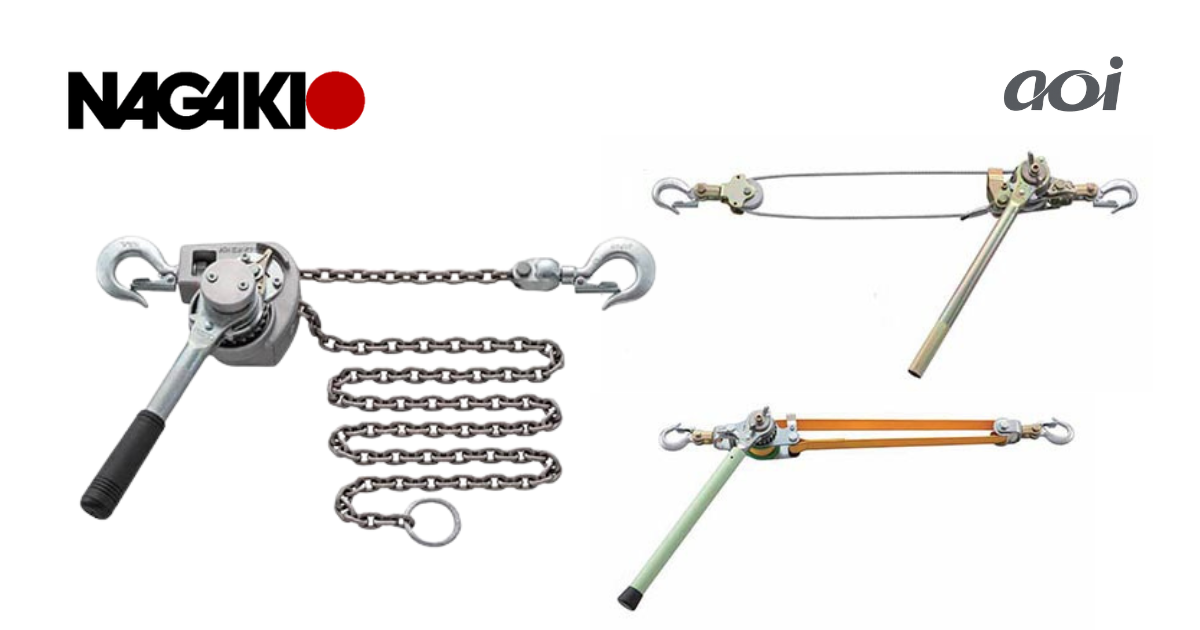
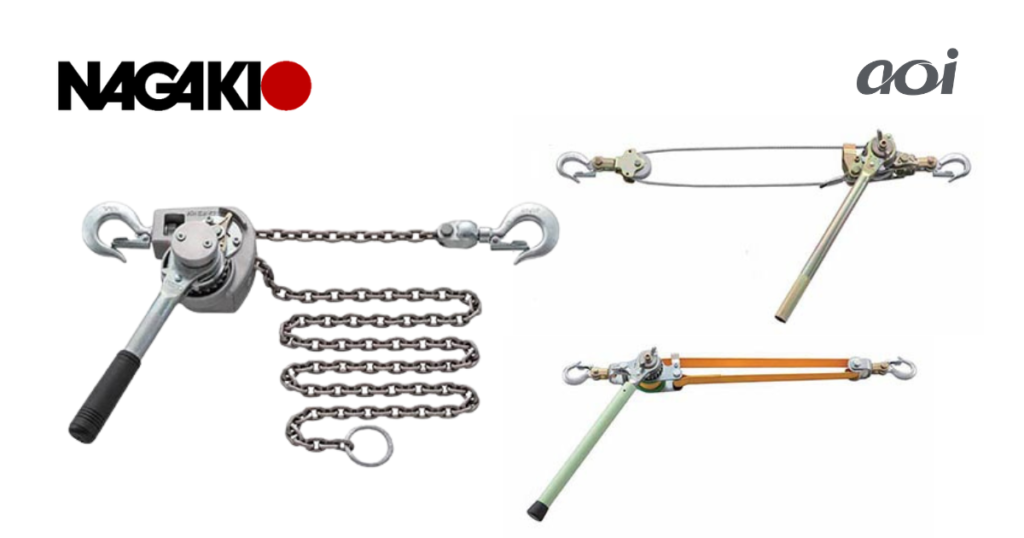
1. Chain Type Ratchet Pullers
Chain type pullers use a steel load chain instead of a wire rope. They’re built for heavy-duty pulling jobs where high capacity and repeated heavy use are the priority — think tensioning overhead conductors, pulling equipment into position in construction and industrial plants. Because the chain doesn’t stretch and is very tolerant of rough handling, this type is a favorite for tougher site conditions, including sandy, dusty, or high-heat environments common across the Middle East and Africa.
Nagaki chain type models: Ricky-2 (0.75t), Ricky-3 (1.5t), MODEL 3000 (3.0t), MODEL 4000 (4.0t), MODEL 6000 (6.0t).
2. Wire Type Ratchet Pullers
Wire type pullers use a steel wire rope as the pulling medium instead of a chain. They’re generally lighter and more compact than chain types at an equivalent capacity, which makes them popular for line-stringing and tensioning work on distribution and transmission lines, where crews need to move quickly between spans and minimize the weight they’re carrying up a pole or tower.
Nagaki wire type models: MODEL 500 (0.5t), MODEL 1000 (1.0t), MODEL 1500 / P-1500-C / P-1500-EX (1.5t).
3. Strap (Web) Type Ratchet Pullers
Strap type pullers use a flat webbing strap instead of chain or wire rope. The wide, flat contact surface spreads the load and reduces the risk of damaging the surface being pulled — which makes this type the go-to choice when you’re securing or tensioning something that could be scratched, crushed, or cut by a chain or wire, such as cable drums, panels, ducting, or lighter structural components.
Nagaki strap type models: N-1000 / N-1000P (1.0t), N-1500 / N-1500P (1.5t), N-1500P-EX (1.5t).
How to Choose the Right Nagaki Puller
Use these four questions to narrow down your model:
- What are you pulling — cable/conductor, chain-friendly steel components, or something surface-sensitive?
- Bare or armored cable/conductor pulling → Wire type / Chain Type
- Heavy, tough job-site conditions → Chain type
- Cable drums, panels, or anything you don’t want to scratch or crush → Strap type
- How much pulling force (capacity) do you need? Nagaki’s range spans roughly 0.5 tonnes up to 6.0 tonnes across the different families. Always size up slightly from your calculated working load rather than choosing the exact minimum — this gives you a safety margin and longer tool life.
- How much working length (stroke) do you need? Models like the P-1500-EX and N-1500P-EX are built with an extended maximum length (up to 3.5m) for jobs that need a longer single pull without repositioning, compared to standard versions of the same capacity.
- How portable does the tool need to be? If your crew is climbing poles or towers, the lighter wire type or compact Ricky-series chain pullers reduce fatigue. If the tool stays at ground level or on a vehicle, the heavier-capacity chain models (Model 4000/6000) are the better fit.
| Model | Type | Capacity | Wire/Chain Dia/Belt Size | Max. Length | Weight |
|---|---|---|---|---|---|
| MODEL 500 | Wire | 0.5t (5kN) | 5.0mm wire | 1,370mm | 2.4kg |
| MODEL 1000 | Wire | 1.0t (10kN) | 5.0mm wire | 1,210mm | 3.1kg |
| MODEL 1500 / P-1500-EX | Wire | 1.5t (15kN) | 5.0–6.3mm wire | up to 3,500mm (EX) | 4.1–5.0kg |
| Ricky-2 / 1.5m | Chain | 0.75t (7.5kN) | 5.0mm chain | 1,800mm | 4.0kg |
| Ricky-3 / 1.5m | Chain | 1.5t (15kN) | 5.0mm chain | 1,850mm | 5.0kg |
| MODEL 3000 / 1.5m | Chain | 3.0t (30kN) | 5.0mm chain | 2,000mm | 8.0kg |
| MODEL 4000 / 1.5m | Chain | 4.0t (40kN) | 5.0mm chain | 2,180mm | 12.0kg |
| MODEL 6000 / 1.5m | Chain | 6.0t (60kN) | 5.0mm chain | 2,250mm | 19.0kg |
| N-1000 / N-1000P | Strap | 1.0t (10kN) | 33mm belt | up to 1,940mm | 3.2–3.3kg |
| N-1500 / N-1500P | Strap | 1.5t (15kN) | 40mm belt | up to 1,970mm | 4.5–4.6kg |
| N-1500P-EX | Strap | 1.5t (15kN) | 40mm belt | 3,500mm | 4.5kg |
Exact dimensions vary by sub-variant. Contact AOI for the full datasheet and to confirm the right pullers for your project. We can supply with any chain length.
Industries & Applications
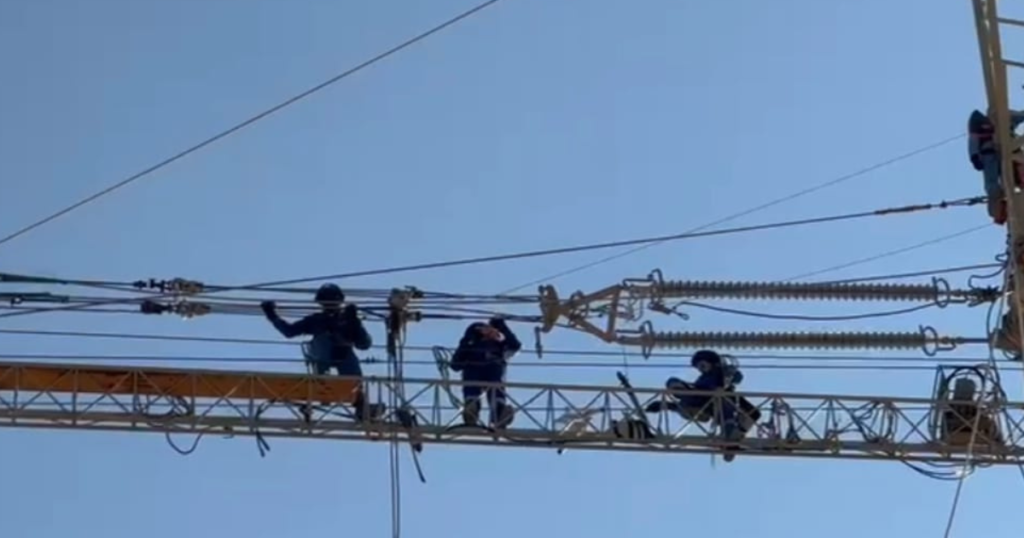
- Power Transmission & Distribution: Tensioning and stringing overhead conductors, sag adjustment – the core use case Nagaki pullers were originally designed for.
- Railway: Overhead wire tensioning and maintenance for electrified rail lines.
- Telecommunications: Pulling and tensioning aerial telecom and fiber cables between poles.
- Construction & Civil Works: Installation of guard rail cable, load positioning, and formwork/scaffolding tensioning on site.
- Oil & Gas / Industrial Plants: Equipment positioning, rigging, and maintenance pulls in refineries and processing facilities — relevant for oil & gas–heavy markets across the GCC and North/West Africa.
- Marine & Ports: Mooring line handling and cargo securing where a compact, high-capacity manual puller is preferred over powered winches.
- Mining: Cable and equipment handling in environments where portable, non-powered pulling tools are essential.
For utilities and EPC contractors expanding grid and telecom infrastructure across the Middle East and Africa, having a dependable manual pulling tool that performs in heat, dust, and remote sites — without relying on power — is a major operational advantage.
Where to Buy Genuine Nagaki Pullers
AOI (AOI-DBI LLC) is your direct sourcing partner for authentic Nagaki Seiki pullers, wire grips, tension meters, and hot-line tools, shipped from Japan to customers across the Middle East, Africa, and worldwide. We work with utilities, EPC contractors, telecom operators, and industrial distributors to supply:
- Genuine, traceable products with full manufacturer documentation
- Model and capacity guidance based on your specific application
- Bulk and project-based sourcing, plus ongoing supply agreements
- Total sourcing support for other Japanese industrial tools, PPE, and testing equipment alongside your puller order
Ready to find the right model? Contact AOI for a quote, technical datasheet, or help matching a puller to your project specs.